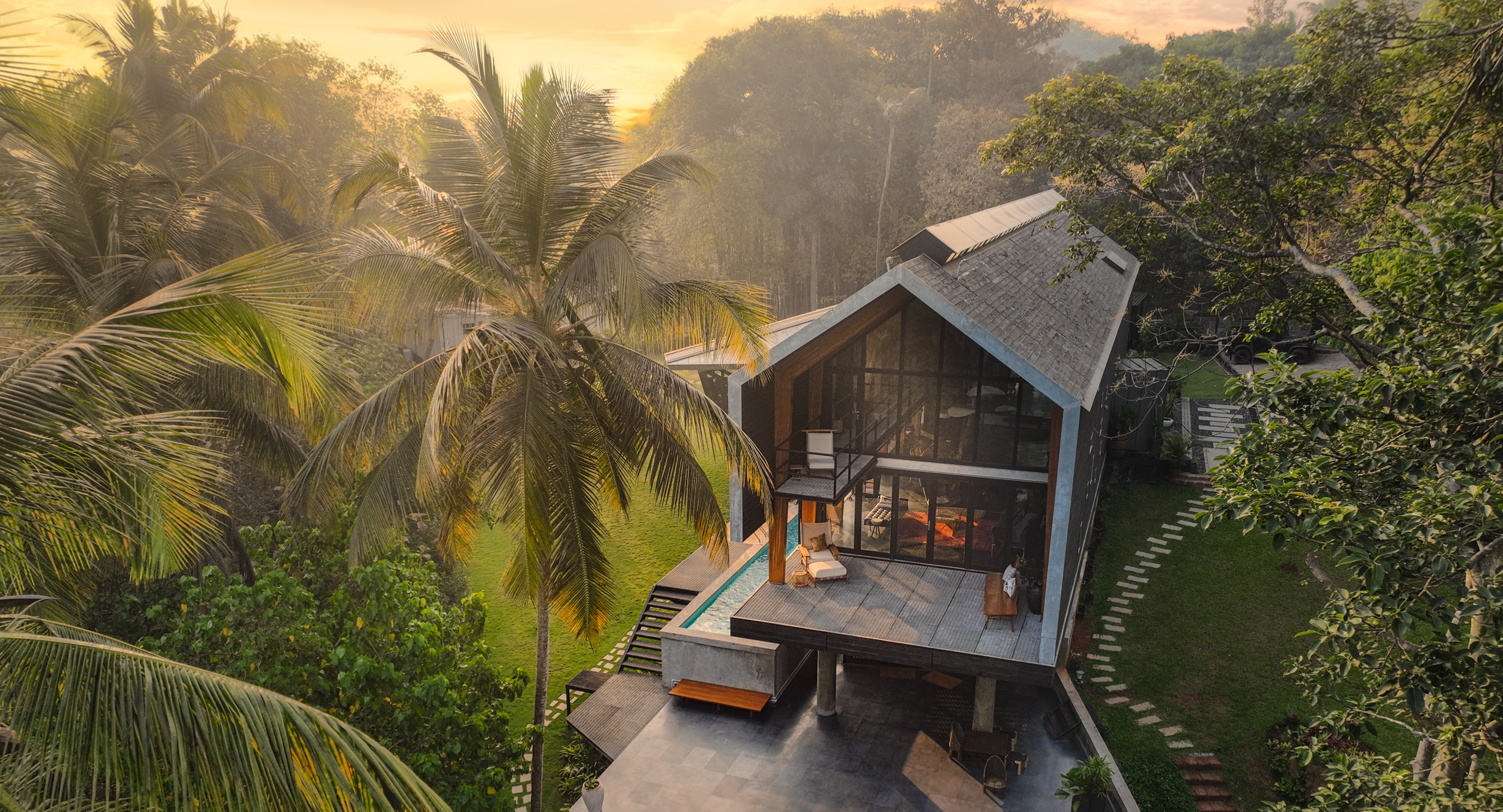

Who says Goa is all about mass tourism and mindless construction these days? The beachside Indian paradise known for its colonial-era Portuguese charm, the most Instagrammable sunsets and a tranquil pace of life — or susegad, as native Goans like to call it — still has plenty to offer architecture aficionados. Take, for instance, the dream hilltop home that the New Delhi-based studio Architecture Discipline has designed for the techpreneur, Sahil Barua.
In a rapidly urbanizing town like Vagator, the house is perched on a forested slope, offering pristine views of the Arabian Sea and yet, its charred wood-panelled facade blissfully blends in with its surrounding flora and fauna. Ensconced slightly above the ground on stilts, the distinctly charcoal-grey residence was built in a way that respects the plot’s natural slope and vegetation while making sure that the final output would be provocative, contemplative and yet homely enough for an e-commerce honcho to lead a mindful as well as meaningful life in close proximity to nature.
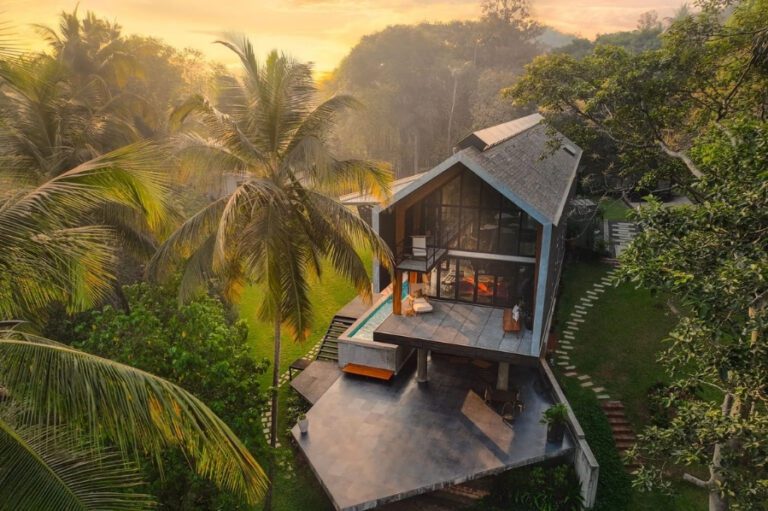
The three-storey building evokes the client’s personality and is perfectly tailored to his needs. Having spent his childhood on the Louis Kahn-designed IIM campus in Ahmedabad, Barua has a profound appreciation for conscious living and robust aesthetics. For his own residence, he wanted to embody a similarly quiet matrix of life — humane, unhurried and deeply attentive to the rhythms of nature and authentic materials.
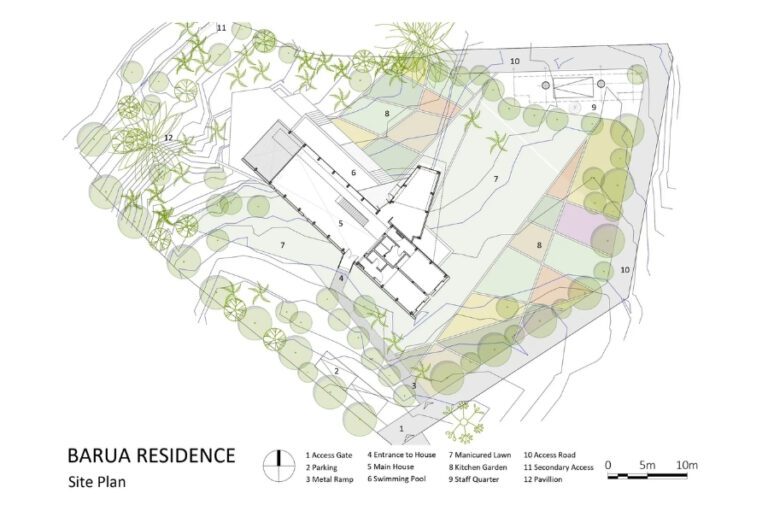
“Sahil is single, lives with his dogs and loves to read. He’s a triathlete and frequently trains outdoors. He likes to cook and entertains occasionally. So, we have a kitchen garden which blurs the boundary between home and nature. The living space opens out onto a metal deck that furthers one’s connection with the landscape. I think what really defines this space is exuberance, clarity and focus,” says Akshat Bhatt, founder and principal architect of Architecture Discipline.
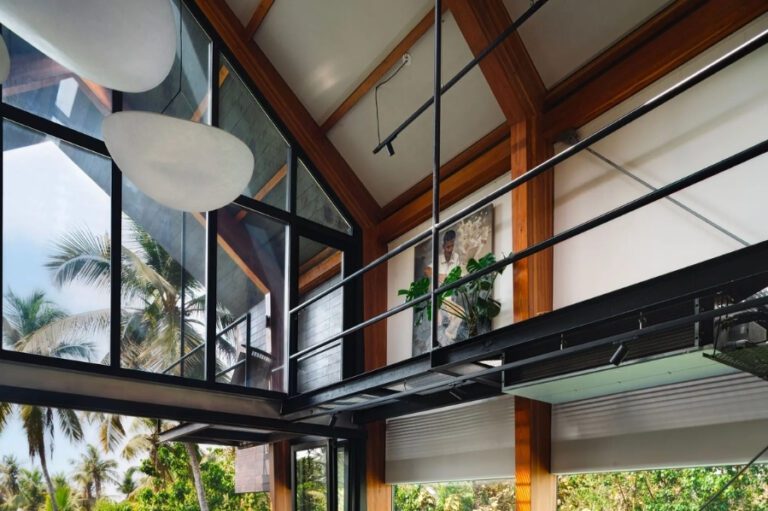
Bhatt sees this project as an investigation into new materials and building technologies that purposefully commit to a sustainable construction process — a much-needed solution to minimizing the environmental impact of the real estate boom. The experimental and playful approach to the construction of this cosy home meant that Bhatt and his team of architects ended up framing the entire structure in mass timber, a pioneering effort that Bhatt hopes will fuel the imagination of other designers.
For the flooring, Bhatt opted for local materials like black-stone while a large portion of the site’s landscape was converted into a kitchen garden that allows Barua to grow his own food. The pitched roof was meticulously crafted to withstand Goa’s heavy monsoon onslaught. Created using yakisugi, an age-old Japanese preservation technique, the charred timber-panelled exterior makes for an ideal choice for Goa’s tropical weather, as it is durable and heat-and-moisture resistant.
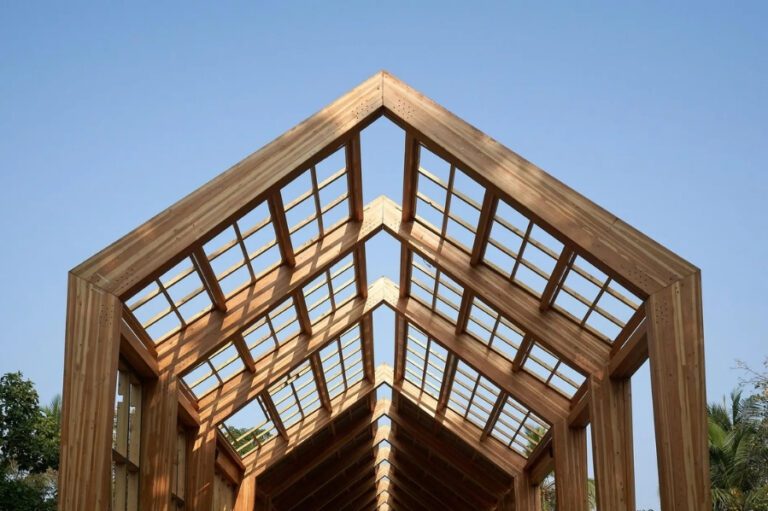
Timber is both raw and tactile, a quality that Bhatt believes makes it flexible, resilient and even beautiful in a rugged way. The unconventional material combines the timeless properties of wood with the industrial strength of modern-day engineering. Comprising eleven glulam portal frames that define the central volume of the home, the three-storey post-and-beam beach house was prefabricated in a facility in Gurugram and assembled on-site in just 30 days by a team of nine structural engineers. It was developed in collaboration with Artius, a company that claims to be building the future with wood.
Asked what was the most challenging aspect about the project, Bhatt quickly acknowledges that it was to find the right team — ultimately Artius proved to be the best choice to be entrusted with engineering the glulam technology. “Not the design intent, nor the conceptual clarity, but the practical matter of finding a company willing and able to realise the project with accuracy and ambition. Progress in architecture is rarely a matter of ideas alone. It is equally about the alliances we forge, the materials we interrogate, and the quiet persistence required to turn vision into form,” explains Bhatt.
Once Artius came on board as the manufacturer for the superstructure, the project took on a duality — engineered with databases harking back to the mid‑70s, yet modelled simultaneously by consulting engineers in India and Canada. “It was, in effect, a transcontinental exercise in retro‑modern pragmatism,” says Bhatt. Subsequently, the glazing systems, building envelopes, pest control and climate control were all approached with the same methodical rigour. Eternal cladding was charred, not for aesthetic flourish, but to guard against mechanical damage and rot. Prefabricated elements emerged from the Gurugram factory, complete with custom‑made stainless steel timber screws, a detail that speaks less of extravagance than of sheer durability. “Artius has helped us engineer and localize everything from the glue used for the lamination to the surface sealants and connectors,” he adds.
Bhatt admits that the mass timber structural system was rather complex but thanks to his team’s thoughtful drawings and details and the expertise of Artius’ engineering and manufacturing consultants made the process easy. According to him, timber as a material is not alien to India’s architectural history and it can be used as a viable alternative to mainstream concrete and steel construction. He alludes to Kashmiri and northeast Indian homes, which are renowned for their wooden architecture.
“We have built with wood for centuries — here in Goa and in countless other corners of the world. Yet, somewhere along the way, we appear to have mislaid the confidence in architecture that is nimble, lightweight, and frugal in its consumption of material,” he says, adding, “At heart, mass timber is nothing mystical. It is simply timber brought under control — engineered, calibrated, and rendered dependable. In its predictability, it is not unlike steel, a material whose performance can be trusted, whose behaviour is known, and whose strength lies as much in its consistency as in its character.”
Away from the bustle of Indian cities, this bespoke timber house was clearly imagined as more than just a sanctuary. It sets a new paradigm for eco-friendly homes in India and beyond. By blending new materials with cutting-edge technology, the architects have created a sleek, forward-thinking space. A proof that sustainable design can be earthy, creative, minimalistic, highly functional — and even “revolutionary,” in the parting words of Bhatt.